Review: 1979 BMW 320i (E21)

I turned 15 years old in October of 1979 and started to learn to drive in my mother’s ’77 Buick LeSabre. Right about that time this 320i was on its way from Munich, West Germany to Salem, Oregon, where it was delivered to the original buyer, who ordered it probably several months beforehand, and yearned for it to arrive. They had specified several high end options (most of which later were bundled into a new model, called 320is at the end of the E21 run, when next 3-series, the e30 was on the horizon) such as Recaro sport seats, BBS wheels, wooden shift knob, A/C, and an upgraded handling package. All wrapped in such an awesome seventies Sepiabraun paint color.

My mom’s Buick had a ~5 liter V-8 (yet still seemed wheezy and sluggish, as all Malaise-Era Detroit machines did), the slushiest of slushboxes, and probably as much extra weight as this entire little BMW sports coupe. I really wanted a car like the 320i, with its nimble handling, sparse, but functional interior, forward-opening hood, and U-boat inspired red dash illumination. But instead I was driving a monstrous barge of a Buick, that could only top the little BMW in perhaps one index of performance: A/C output. I’ve always believed that the world’s finest air conditioners are provided by General Motors, wrapped by immensely mediocre vehicles. Mom’s Buick was that, to a “T”.

I read about BMWs in my father’s Road & Track, and Car and Driver magazines. The writers always proclaimed the BMW 3-series as “A Driver’s Car” with tales of delightful responsiveness and handling. BMW ads in those magazines told about how they hand-crafted every car, and manufactured in one year, as many cars as Detroit churned out every day. They built them carefully, and with perfection in mind. In other words everything my mom’s Buick could never be. Those little Bimmer coupes just seemed like such a cool compromise between a sports car, and something practical. You could put four or five average 1970s-sized Americans into one, and fill the giant trunk with luggage, or groceries, or BOTH, and still have fun driving it around.

Practical Fun!

Practical Fun indeed. It is clear the original owner loved this car. They made a few tasteful, period-correct modifications to it, including lowering springs, and replacing the Mahle-BBS gold/silver basketweave wheels with a set of Enkei silver basketweaves. The fog lights disappeared at some point; though wires and switchgear remain. The car spent its entire life in Central Oregon, and I even saw it from time to time when I was driving my son Nick to Bend High School circa 2011-12. The original Owner’s family sold it on Craigslist, to a guy in Portland. Shortly thereafter, that guy moved to Los Angeles for a new job and discovered that this car can’t be registered in California without some modifications to make it pass an emissions test (it is from the “49 State Car” era, when manufacturers made California-specific models.) Since it is a remarkably original car, he made the decision to sell it, on the then-nascent Bring A Trailer auctions. I bought it on a whim really. It was (relatively) cheap, and something that I had always wanted since those days of driving my mom’s Buick.

Up until a decade ago, I had never actually driven a BMW. Shocking I know. My garage had been mainly a Volkswagen sanctuary, with half of those being Diesels. I’ve driven Jaguars, Porsches, and a whole bunch of Mercedes-Benzes (including the 300sl), and a bunch of other machines, but for some reason BMW was something I’d yet to drive. That changed in 2011 when I not only drove a BMW, in this case the iconic successor to the 320i, the E30/325i, but this first driving experience was also on a racetrack, in wheel-to-wheel competition!

It was on that weekend that I finally experienced “The Ultimate Driving Machine”. It was worth the wait. I had a blast throwing that little coupe around the track. It was fast, fun, nimble, and everything I had imagined the BMW driving experience to be. The predictable and easily controllable oversteer was the icing on the cake. Mind you the interior was stripped to bare metal and I was surrounded by a roll-cage, so I wasn’t getting the full picture, but what I did get was as addictive as crack. I bought myself a BMW within a year.
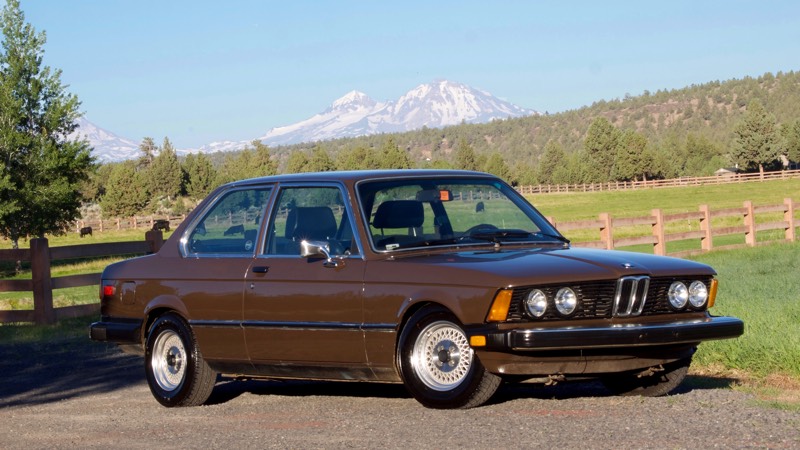
When I saw this brown E21/320i on Bring A Trailer, I was inspired to bid on it. Not only because it was a BMW, but it was also an under-appreciated classic, and needed to return home to Central Oregon. Over the past several years it has become my favorite car for a Sunday drive. It never fails to bring a huge smile to my face. Sure, it is a tad under-powered, but it is a rocket-ship when compared to the cars I drove back in those days… the aforementioned Mom’s Buick, and the first car I ever called my own, a 1980 VW Rabbit Diesel. The Buick had nothing but bulk, and noise, and ice-cold A/C. The VW had 40 HP and a spare, Teutonic gestalt. It was like a tiny fraction of a BMW 320i. 0-60 measured in minutes, but a lot of room on the inside in a small, lightweight chassis.

What makes the 320i so fun to drive is it just feels so tossable. Like an extension of your mind, wrapped in a Paul Bracq sculpture. It is beautiful, practical, fun, and above all else, an icon of 20th Century Industrial Design. It makes all the right noises. It provides all the right feedback. What it lacks in sensuous curves and impracticality, it makes up in spades with functionality and fun. They’re from an era when “adding lightness” was on top of every automotive engineer’s mind – mostly for a shortcut to fuel economy, but the Germans did this better than anyone. They didn’t just shrink big cars, they designed small cars to be what they could and should be.

In other words, everything my mom’s Buick never was.

The car brings a remarkable number of thumbs-up and appreciative waves from a fairly wide demographic on the road and in parking lots. The color, the design, the 13″ wheels, and the quad headlights just proclaim to the world “Late Twentieth Century!” in such firm and Germanic language. Unlike the “Cindy” E30/325, and the “Marsha” 2002, the “Jan” E21/320 is late to being recognized for the prize it really was for BMW. It saved the brand, and was the first chassis to sell a million units for them. Sadly, so few remain, and especially those in such excellent, original condition.

Saved again by Mike Valentine…

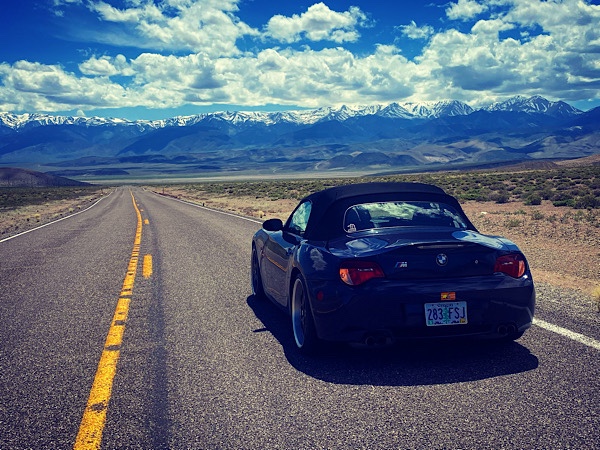
I was heading down to Bend last week to meet Linda to watch the latest Bond flick ‘No Time To Die’ at the McMenamins Old St. Francis theatre. Zipping along on US97 southbound, which while not a freeway in the traditional sense, it is as close to one as we get in Central Oregon. I was in the Z4M, enjoying the last few drives before it is put away for the winter. (Every time I drive this car I think “I should drive this car more often!”… it is the much fun to drive.) For the past year or so there has been some roadside construction on 97 on the north end of Bend. No idea what the project might be, it’s not actual road construction, but something alongside it that has taken quite a long time to complete. So for a long while the speed limit has dropped from 65 MPH down to 45 MPH through said construction long before you reach the usual traffic clusterfsck that is the north side of Bend around Cooley & Robal lanes.

So I’m rolling along all by myself with no traffic ahead and none close behind for the whole section from Tumalo to Bend, and as I’m approaching the construction warning signs I get a STRONG Ka Band signal on my Valentine1 radar detector. A glance shows me that it’s signature arrows are showing me the signal is behind me. I glance in the rear view mirror and all I see is a Subaru in the left lane coming up fast. I’m in the right lane already, but knowing that the construction zone is coming up AND there is an L.E.O. behind me with active radar, I come off the accelerator and begin slowing to the construction zone speed of 45 MPH. Sure enough the Subaru blows by me at likely 75 MPH as we enter the construction zone. I glance in the mirror and see the unmistakable outline of a Dodge Charger in dark blue and yellow. The Oregon State Patrol. As he passes me he lights up and accelerates to what is likely well over 90 MPH to catch up to the Subaru. (oh the irony!)

I can only imagine what the cost of that ticket must be for the Subaru driver. 20+ over in a Construction Zone. Oh boy.

Dime holding up a Dollar…

The proverbial dime.

The M Roadster is now getting old, so I’m having to dive in and tend to things. One of the bizarre weaknesses of this race-bred engine is this tiny little filter that is located in the VANOS Solenoid pressure relief valve. Apparently if clogged this thing can ruin your day, and your VERY EXPENSIVE engine along with it. Given the age and mileage, and the fact that I’m planning on a weekend trip, the time has come to attend to the task. Thankfully, it’s relatively simple.

Pop the unit out of the head, thankfully located in a very easy to reach spot at the front of the engine:

22mm wrench right there.
And… Remove.

The process at this point it to remove two old o-rings and the filter at the end of the unit. Mine did not look that bad. Very little in the way of clogs, but certainly worth a swap.

Old filter.

The o-rings were old and crusty and came right off with ease. The filter not so much. The plastic was very brittle and it basically disintegrated as soon as I tried to pull it off with needle nose pliers. I had to resort to a pick to remove the final, base ring.

New filter.
Reassembled unit, with old parts adjacent.

Popped back in the head and ready to go.

E24M Power Steering pump rebuild and reinstall.

Freshly rebuilt power steering pump.

When I drove this car home from its previous owner in Wisconsin I noted an odd, barely perceptible vibration when the steering wheel was anywhere right of TDC. It grew worse over the following year, to the point I stopped driving it. From the leaks I could tell that this pump was dying. Eventually all the fluid came out, even while parked.

I replaced the alternator soon after driving it home (its bushings had collapsed) so it’s not surprising that these thirty-plus year old seals had hardened to the point of uselessness. I also was a bit daunted by the pump’s location and what appears to be a complicated bracket setup. The alternator turned out to require removal of some radiator hoses, which didn’t happen this time, but it still wasn’t easy.

The PS pump has two hydraulic connections, and a multiple set of brackets on both front and back, along with a toothed adjustment bracket to set the belt tension.

It was tough to remove, mostly due to the difficulty in reaching the top hydraulic banjo bolt. Thankfully I had the car on the scissor lift and could find the sweet spot for reach while lying on a carpet remnant on the cold concrete of the shop floor. It took multiple attempts at multiple heights to get all seven or so regular bolts and the two banjo bolts undone. I then sent the pump off to a guy in California for the rebuilding.

A bit of hilarity ensued when he mixed up two pumps and sent each to the wrong clients. Thankfully he figured out quickly where each of them were and had us ship them to each other on his dime. I don’t mind some human error now and then, what matters is how it gets handled. Compared to our experiences with Dan Mooney of Classic Jaguar (which was a costly nightmare) this experience was smooth and I’m still a happy customer in the end. This car needs another pump rebuilt, and I’m very likely to send it to the same guy. He was fast, communicative, and swift to rectify his shipping error. The pump looks great (almost like new, only the “West Germany” label betrays its age!) and arrived pre-primed with fluid. So far I’m impressed.

Less impressive is my mechanical ineptitude as always. It required three attempts to get it back into the car properly. All due to me. 100%. On the second attempt I figured out that the hydraulics need to be attached FIRST since the hoses have to be “just so” in order to properly sink those banjo bolts into the right spots. Of course, they are not visible while you’re doing this and so you’re holding up the pump with one hand while reaching around to the top with the other to blindly turn a bolt, hose, and two washers (which always want to fall out and roll off to some dim, unlit corner of the shop!) into the right spot. After I figured that part out, I found that the adjuster bracket really needed to be installed on the bench prior to installation in the car:

Proper pre-installation of the adjustment bracket.

One more lap around the hydraulic hose install and then one fixed bracket bolt and THEN the adjustment bracket and finally all the other bolts and it is done.

I figure about the time I figure everything out, I’ll die.

But at least now I can get this car moving under its own power again, and off the lift so I can get back to swapping snow tires on and off cars. Winter has come!

Back in the car.
My chilly workshop.

The very gates of hell…

Or at least, of purgatory. I bought an automatic gate opener for the front of our property last year. It serves as a barrier of last resort to keep the livestock from escaping. The gates existed before we bought the place, I just added the openers. It has turned into a project that never ends.

The main problems have been the proper operation of the various components involved. Last year when I first assembled it, the main problem was getting wiring under the driveway to the far gate. Since my end goal was to have a keypad on the driver’s side as you enter I put the whole system on the south side of the gate which would be that side. It came with a sensor to bury along the inside of the property to trigger opening as you drive out. I assembled the basic components and used an existing irrigation culvert under the driveway to route the wiring for the far gate. The distance through the culvert was too far for the stock wiring so I had to buy some sprinkler system wiring to extend it. The gate worked okay using the remotes, and winter arrived before I could assemble the keypad and exit sensor. This meant that we had to use the remote or an app on our phones to open the gates for anyone entering and leaving the property. This was fine for a while, but a bit of a pain.

In June I began putting the rest of the system together, starting with the exit sensor. Unfortunately when I connected it I noticed that the gate would open randomly, and sometimes often enough overnight to drain the system’s small 12v battery (which is charged by a small solar panel.) I also learned through this process that due to our latitude the solar panel was barely enough to run the system through a dozen or so open/close cycles a day. Thankfully you can daisy chain solar panels together to increase the rate of recharge, so I bought two more and arrayed them down the south side of the gate entrance. I called tech support about the random openings and narrowed the cause down to the proximity of the south pasture fence and it’s steel posts to the sensor. The only solution was to move the sensor to the other side of the driveway!

This meant disassembly of the entire system and relocation of the controller, sensor, and solar panels to the north side of the gate. Also I would need to reverse the two gate opening arms, meaning a re-running of the wiring through the irrigation culvert under the driveway. Doing the task the first time was by far the hardest part, and I wasn’t looking forward to the chore. This summer’s crazy wildfires and unbelievable smoke prevented me from ever getting to it until now, when once again I’m staring down the barrel of winter.

The new wire conduit route from the culvert to the control box, now on the north side of the gate.

When I installed it last year, I ran flexible conduit through the culvert. I figured it was time to replace that with something more permanent and sturdy. Everything was buried under dirt, rocks, and weeds, so finding it was going to be interesting. I used the loader of my tractor to gently scrape the surface back and forth until I unearthed the old conduit.

I asked my friend Brian over to help, as pulling fish tape, pull strings, and wire through conduit is much easier with some at either end. He informs me that there is a device that uses a garden hose and conduit to burrow under and through things like sidewalks and driveways. If I could burrow a straight shot it would vastly simplify the whole system and remove the need for extra wiring. We go to the hardware store and find the device, which is only about $5.

It (almost) worked. I was amazed at how swiftly it zoomed through the first quarter of the distance Sadly, it all ground to a complete halt about one-third of the way under the driveway. With daylight fading, we abandoned the idea and reverted to the original plan of re-running conduit through the culvert.

We rough together the conduit and fish a pull string through as dusk approaches.

The next good weather day I pull wire and re-build the entire system reversed from the original layout and of course the sensor continues it’s odd behavior of randomly opening the gate. I spend a while on hold and get nowhere with tech support, who focuses solely on providing proof of purchase to verify that it is still under warranty.

I dig through my history of the purchasing and find that this unit was bought fifty weeks previously. Yep, I’m two weeks inside of warranty! I call them again and finally get a guy who is motivated to solve my problem. He authorizes a return and ships me a new sensor ASAP.

I’m so close to finishing this project, yet still not quite done. And of course, winter is coming.

Go Home Facebook, You’re Drunk…

I’m freshly out of “facebook jail” about a thirty minutes ago. I haven’t been able to post, like, or comment on Facebook for three days. What heinous crime did I commit? Well, according to Facebook, I violated their community standards, specifically I engaged in “hate speech.”

I would imagine that most of you would be surprised. I don’t really participate in politics or political discussions, either in real life, or online. Why? I have always believed that a true key to a peaceful life and a polite society is to not discuss politics or religion. These are highly divisive topics. Likely over ninety percent of human conflicts have hinged on these topics, and by extension most of the death and destruction throughout human history. I have political and religious beliefs, but none of you know what they are because I keep them to myself. The world would be a better place if most folks lived this way. Sure, I vote, but nothing I see on Facebook is going to change how I vote, and I’m not so foolish as to believe I can influence how anyone else votes. So I don’t even participate in online political discussion.

So what did I do on Facebook that landed me in “hate speech” jail?

As some of you know, I worked at Facebook from 2010 until 2015. I helped build, and for a while managed Facebook’s very first self-built datacenter in Prineville, Oregon. Along the way I helped select and train the staff hired to build several subsequent datacenters, namely Forest City, NC, Lulea, Sweden, and Altoona, Iowa. I’ve remained friends with several of these folks, including a Swede named Daniel. Daniel and his family came to Oregon in early 2013, and we discovered that we shared some passions, namely datacenters, mechanical things, ice hockey, and skiing. I make silly comments on his posts now and then, including three days ago when he posted a photo of his lawn, covered in Canada geese:

Geese on Daniel's lawn

If you look closely you can see that I commented “Damn Canadians!”

After I posted that, I clicked on some other thing in my newsfeed (a video from the NHL) and it was interrupted a few seconds in by a pop-up box that said that I had violated FB’s community standards around “hate speech”… I took a screen shot of that, bounced back to Daniel’s goose pic and posted that as a comment figuring it would be even funnier than my original comment. It worked.

I then went on to scroll through my newsfeed of hockey stuff, car stuff, and friends’ posts. Within less than a minute however I was barraged by the automated Facebook AI Thought Police, who wanted to inform me of my (few, if any) rights and that I was going to be put in FB Jail for my clear crime against humanity. I dismissed the dialog box barrage as best I could and switched from my smartphone to my laptop as I know from experience that FB’s mobile UI is a suboptimal place for serious business (such as making jokes about birds.) I tried to appeal, but was only met with vague errors:

Unhelpful

I really enjoyed my time working at Facebook (except the last 100 days, which were terrible, but a story for another time) and one of the things I appreciated about it was the level of focus evident at every level of the company. It was only 1500 people when I joined in 2010, and FB had just passed the 500 million active users mark. The impact of 1500 dedicated people building infrastructure to support half a billion users was an astounding thing to consider. I often described working at FB as the ultimate embodiment of Adam Smith’s concept of the division of labor: by hiring people for very specific skills and leveraging those skills as much as possible, a very few could create and maintain systems used by hundreds of millions, if not billions of people.

Less than a year after I joined, Facebook was faced with a true existential threat: Google, a company over 10X our size, was launching their own social network, “Google+”. I happened to be in Palo Alto at FB HQ the week it was revealed and our CEO, Mark Zuckerberg called an all-hands meeting. He described how the company had faced these challenges in the past, when the nascent social network business was a cluttered field, and the efforts that were successful in growing FB to meet those challenges each time. But Google was another thing entirely. They had 10X the staff, and rumor had it that they had more engineers dedicated to G+ than FB had people. Google’s infrastructure was well over 10X ours at the time as well. They had a global fleet of datacenters with likely more than a million servers, perhaps more than two million. Facebook had two leased wholesale datacenter groups in the Bay Area and Northern Virginia, and two self-built datacenter campuses, one that had just come online a couple of months before (and still being built), and another under construction and likely not to go live for many months. Server count was still well under an eighth of Google’s. Clearly Google had a huge leg up in terms of ability, and all FB had on our side was momentum.

Zuck outlined the plan for how we were going to counter that threat, finished with a story from Roman history, and a final exhortation: “Please guys: Don’t fuck this up!”

We, as a company, didn’t fuck that up, as Google+ sits now in the dustbin of history, but I’m telling you Facebook is fucking things up today. Not big things, but small ones that erode user trust. Such as using an algorithm to detect and take action on “hate speech” that fails to understand context, such as a funny comment about birds. But even more so when the user-prompted process to correct the error also utterly fails.

Oddly, I have avenues available to me that the vast majority of FB users can’t imagine. I used to work there and know plenty of people who still do. I reached out to several to try and sort this out, but ultimately none of them could spring me from FB Jail. So I had to wait until my sentence was up.

The one thing everyone who is still working there tells me is: “It isn’t like it was… it is much worse.” The company is now tens of thousands of employees. It is cursed by a complete lack of existential threats, and huge revenues. Why is this situation a curse? It deprives them of any real need to care. It deprives them of that focus that made it initially successful. Facebook will never truly address their real problems until they either start losing lots of money, or something comes along that truly poses them a threat to their existence. Meanwhile, they’re just stumbling, unfocused, from mistake to mistake without any corrective measure being taken, because their mistakes don’t hurt them. They only hurt their users.

Zuck, you are fucking up.