
Today is Sir Stirling Moss’ 80th birthday, and here’s wishing him a good, and many more, days and years!
Here’s a shot of one of his old cars, obviously used for rallying. Can you name the make and model of car?
goolsbee.org, serving useless content from an undisclosed location since 1997
I am a “car guy”… I love old cars.
Today is Sir Stirling Moss’ 80th birthday, and here’s wishing him a good, and many more, days and years!
Here’s a shot of one of his old cars, obviously used for rallying. Can you name the make and model of car?
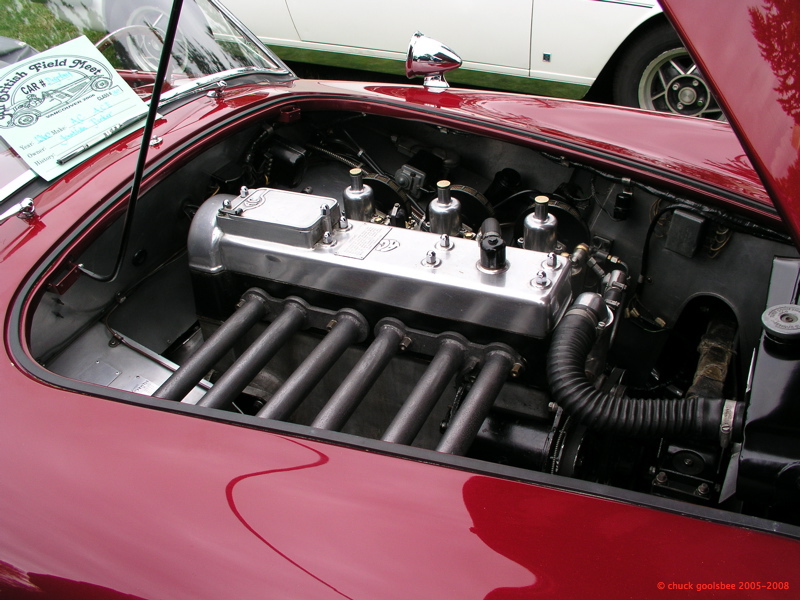
Speaking of the ABFM at Van Duesen Gardens in BC and looking at engines… This one, an AC Ace, was one of the best seen that day. (No guessing games today as the placard identifies the car!) Gorgeous.
Perhaps the car spotters here can get some exercise naming the car in the background.
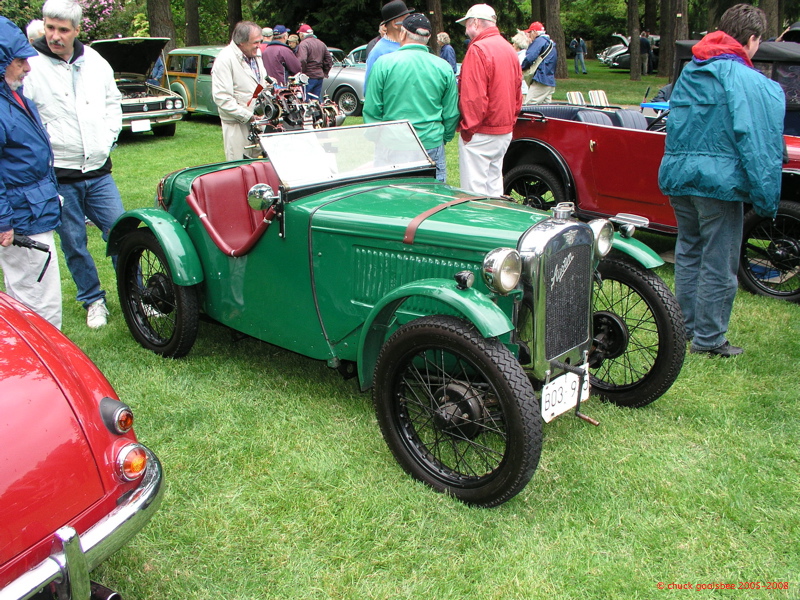
This old Austin Seven was seen at the All British Field Meet in Vancouver BC several years back. Nick & I went up for the day in the 65E, toweled off the car, and pretty much abandoned it as we wandered all over the grounds of Van Duesen gardens admiring the cars. I love to look at pre-war cars, and someday would love to be the caretaker of one. These little Austins are not really my style but this car came with a bonus, which you can see behind it…
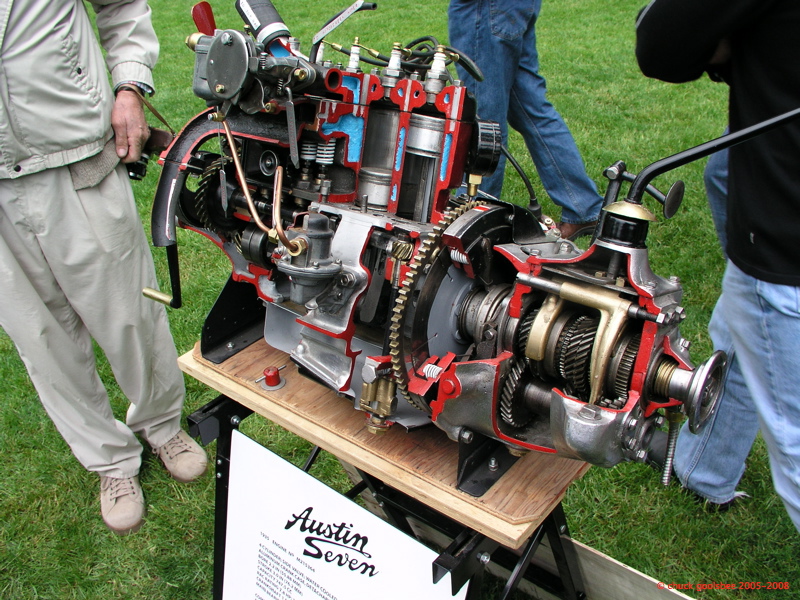
Near the little Seven was shown this cutaway… I love looking at engines. What gearhead doesn’t?
Nick relished this display for the cogent illustration of the basic functions of the drivetrain components of a car. Cutaway engines are fairly common but this one also included the clutch and gearbox so it really does a far better job of showing the process. Nicholas learned about timing, fuel-air mixture, bore & stroke, lubrication, intake and exhaust cycles, the transformation of reciprocal into rotational motion, the purpose of the flywheel and clutch, and how gearing works. Seeing this in the flesh, and turning the engine by hand does so much more for illustrating the process than my standard “go to” Animated Engines. This old side-valve engine of course is primitive, but the concepts remain the same to this day. From this basis I was able to show Nick the engines in other cars on the field and explain the subtle differences, such as overhead valves, various cam-driving solutions, and of course cylinder configurations.
What a neat thing to bring along to a show.

This car looks so sad… shivering out in the (admittedly sparse) weeds. I almost tagged this under the “Still life with…” category, but that would be mean. The car is quite rare, and I can honestly say it is the only one I’ve ever seen.
I shot the photo many years back, and I know at least one commentator here knows exactly what it is, so he’s ineligible for guessing, though he can referee for those that do guess, as he knows more about this type of car than I do. Do you know what it is? Take a guess in the comments.
(Note, as I’m behind of CPotD posts, there may be more than one today, stay tuned)
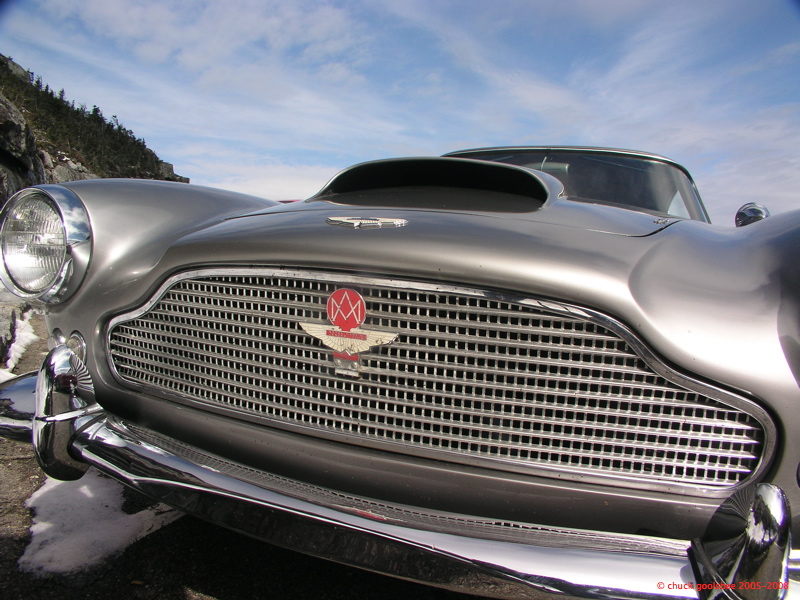
While I (oddly) have no desire to own an Aston Martin I do really love to look at them. While I can pick nits about many minor deficiencies of this particular photo, the subject matter as a whole redeems it. Enjoy.
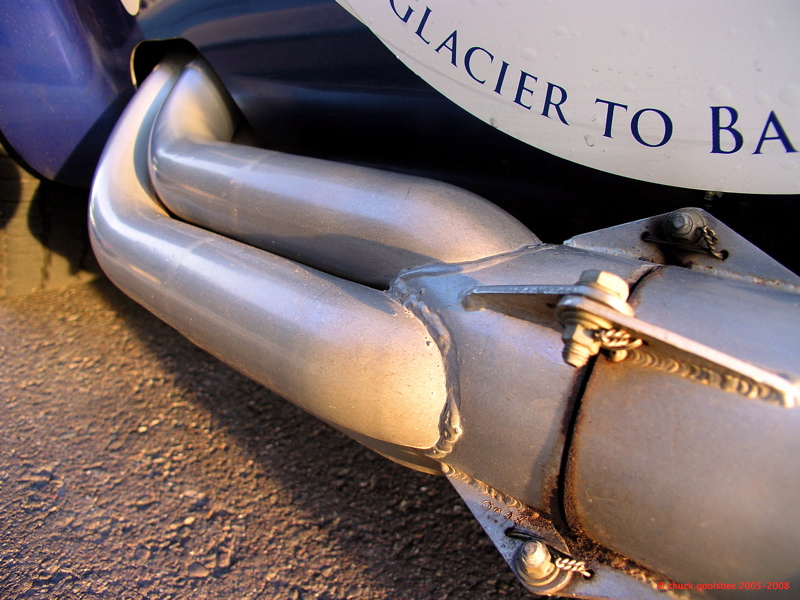
After an exhaustive search through my catalog of car photos I settled upon this contemplative view of an exhaust pipe.
“Exhaust” is one of those odd words when you look at it. It has Latin roots, yet has a Germanic look to it. Perhaps it is just the “haust” part that makes me want to hoist a lager and down a bratwurst. How the explosive release of combustion vapors relates to the draining of physical and mental resources I don’t know. These big pipes never look tired. Sure, cars run out of energy when their tanks run dry, but I rarely equate that with the wonderful noises that often come from exhaust systems. Exhaust notes make their cars seem positively energetic in fact. Only when a car sits idle, with that creaking and popping moans coming from its metal as heat is lost to the air around it does it seem at all “exhausted”. Yet we know that is an illusion. The turn of the starter, is all it will take to spark the machine alert and alive once again. Like the sound of food hitting the dish that brings the sleeping dog to full sprint, the car is never as exhausted as it appears. Until of course, it ceases to function entirely, at which point the exhaust system is just a series of inert metal pipes, rusting at a slightly higher rate than the rusting parts around it. It is then that we can truly say that car is exhausted.
I’m not a very good mechanic, but I enjoy working on my cars. Part of it is because I’m cheap, and don’t like spending money on things that can be done myself. The other part of it is that every time I have any interaction with any part of a car dealership, I walk away feeling like a rape victim. Silkwood showers. Haunting regret. The works. Determined to rid myself of that feeling of being used, I made a commitment to gain the skills, and free myself from abuse. There are still a lot of jobs I don’t feel competent to perform on my own, but having the knowledge of how things work prevents me from being at a disadvantage when I buy the services of a professional.
I started by doing oil changes. The procedure itself is so simple that it boggles my mind that anyone pays for the task. Yes, time is money, but a car is a huge portion of the cost of living, and its longevity is abetted by proper maintenance. Knowing that it is done properly adds peace of mind to that longevity. I keep my cars as long as possible and generally wear out their interiors before their drivetrains. Oil changes are the most basic, yet vital maintenance step you can take to keep your car running a long time. Mechanically the process boils down to removing old oil, and pouring in new oil. If you can cook yourself dinner you can change your own oil. The most difficult part of the operation is getting underneath the car to drain the old oil. Now that is no longer an issue!
I first heard about removing the oil out of an engine via the dipstick hole on a mailing list about Diesel Mercedes-Benz cars that I read. Mercedes-Benz dealers only do through-the-dispstick-hole oil changes. I always thought it seemed silly, but now I’m a convert. I recently bought a Mityvac 7201 Fluid Evacuator Plus from Amazon. The event that lead up to my purchase was an accidental over-tightening of the drain bolt in my wife’s Jeep Liberty CRD. Last time I changed her oil I wasn’t paying attention and over-did it when putting the bolt back in. I didn’t strip it completely, but I felt that little “give” that told me I’d be doing a heli-coil job on her pan at some point in my future. (Remember I said at the beginning that I wasn’t a very good mechanic!) I did the bodger’s trick of sealing the bolt in silicone to hold it over until I can fix it properly. Meanwhile I’m still going to have to change the oil. Hence the The Mityvac 7201 Fluid Evacuator Plus.
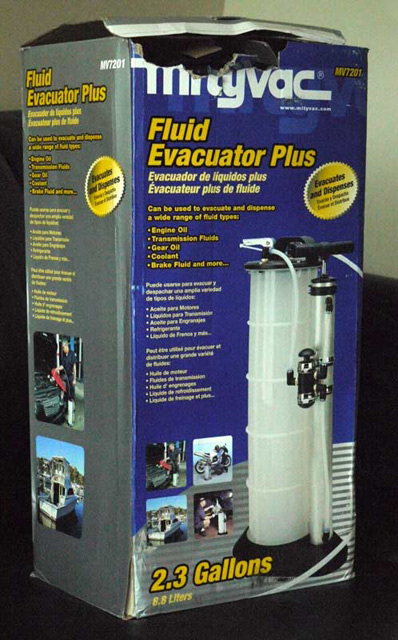
The unit arrived with a damaged box, which is never a good start to a relationship. Thankfully no parts were missing and nothing was damaged. Included in the box was the unit itself, two different diameter extraction tubes, a main tube, and an instruction manual. I’m one of those guys who reads the manual of every thing I buy, so I sat down to read the skimpy pamphlet that serves as the unit’s instruction manual. It took all of about 32 seconds to complete. I can paraphrase it for you right here:
Here is a photo of it in action this morning on the wife’s CRD:
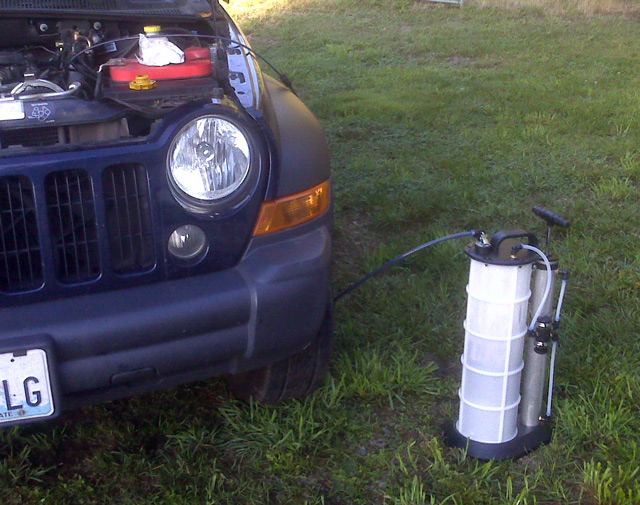
It takes about two minutes to suck the oil from a 6.7 quart capacity engine like this VM Motori 2.8L CRD. My 4.4 quart TDI took less than that. When it hits bottom and all the oil is out you’ll hear it sucking air. Once finished you pull the extraction tube out and off, insert the main tube into a good portable oil reservoir, flip the switch to “Discharge”, and it’ll blow out the old oil into something handy to carry it in off to the recycling station. Fill your engine with the proper amount of new oil, replace your cap and dipstick, and you are done. You won’t even get your hands dirty! Much faster than draining too.
Unless you have to also change a filter you won’t have to get under the car at all. In the case of my TDI, the filter is on top of the engine, so with that car the entire operation can be done from above. No muss, no fuss. No ramps, no jacks. There are other units besides the Mityvac 7201, but I chose this one for its size and discharge capacity. Some of the cars I care for are vintage machines with 11+ quart oil capacities. (The discharge feature also makes it useful for brake bleeding but I haven’t tested that yet.) The Mityvac 7201 is expensive at around $75, but a budget-minded gearhead could find a usable substitute for as little as $45. If you want powered options (electrical or compressed air) plan on spending a few hundred bucks.