Back in June of 2000, I joined my father in his then new-to-him Jaguar XK 120 for an absolutely looney car rally called the La Carrera Nevada. The year before we had driven through Nevada on the Cannonball Classic in the E-Type. Our minds were blown on US 50, as it traversed Utah and Nevada. I became enamored with the Basin & Range country and the delightful driving to be found there. Now, twenty three years later, I am living at the far northern edge of The Great Basin and take opportunities to explore it by car whenever possible.
There is an event I like to attend in Las Vegas every June and half of its appeal to me is the chance to explore new roads in this great American outback of the basin & range country.
I had hoped to once again traverse Nevada, but this time west-to-east on US 50, and then turn south on Nevada Highway 318 (Home of the Silver State Challenge) down to Vegas. 318 is a road I have never driven, especially the section where they run the SSC.
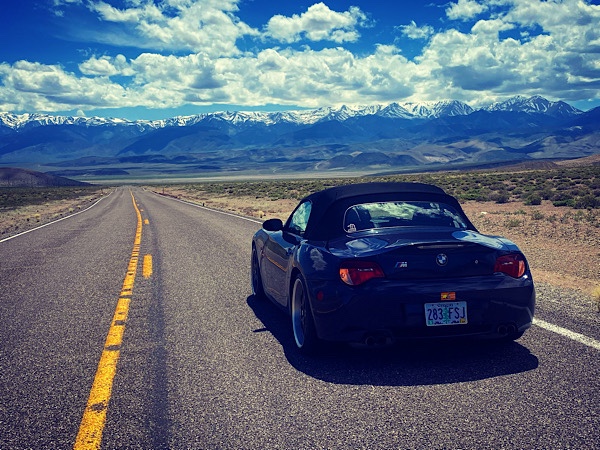
Well, fate intervened and as I was leaving Fallon east on 50 my TPMS light on the dashboard of my 2007 M Roadster lit up. Just a week and a half ago I had finally replaced the long-dead TPMS sensors in the car and now for the third time in three days the idiot lamp had lit. The passenger side rear tire had been losing pressure ever so slowly and I would just stop and add ~5-10PSI and keep driving. But now, my brain and the light told me “get this checked you idiot. You are about to head into a vast blank spot on the map filled with empty roads and sparse cell phone coverage!”
I hung a U-turn and backtracked through the town and went to a Les Schwab tire store. They diagnosed it as a leaking valve stem. Sadly, the delay was enough to put the kibosh on my Highway 318 dreams, as I was expected at a dinner in Vegas at 8:30 pm and it was almost noon. The margin was just too thin.
If I just went south on US 95 I would be in Vegas in around five hours, but I just couldn’t bear to do that. 95 is the main route between Nevada’s two population poles of Reno and Las Vegas. It is choked with truck traffic and of course I had driven it before. I’m here to explore.
I know that if I go east on US 50 there are several possibilities of highways heading south that will get me there with some wide open horizons. I have driven several, but there may be one or two new ones. Sure enough I see Nevada 361 and check my memory about if I have driven it before. I can’t recall if I have, but it seems like a good option, so off I go.
At first the asphalt is smooth as silk, clearly repaved within the past few years. I think I see maybe four or five other vehicles. Nice road to open the taps and let the S54 pull like it was born to do. Well, at least until I get about halfway, and the road surface gets as rough as a fifteen year old boys’ pimply face. Oh well, it was fun while it lasted. And then 361 ended at US 95. I resigned myself to just loping along with the traffic on 95 from here to Vegas.
One moment of amusement happens along here. There is a long line of traffic with a slow truck at the head of it. At an opportunity where I can see for miles, and a break in oncoming traffic coincides, I drop down three gears and pull a long pass. A distance behind the slow truck is a Ford Explorer in dull grey, and sporting those swivel-spotlights on it’s A-pillars that scream “COP CAR” to everyone – except me. Why? The Ford has Oregon plates, but they are just regular civilian plates, not the orange ones they put on actual state fleet vehicles. I pass it, chuckling, and have to pull in between this fake cop and the slow truck several car-lengths ahead of it as oncoming traffic has returned. Laughing to myself as I pass the truck finally I vanish over the horizon amused at the dozen vehicles stacked up behind that Ford for the next 250 miles.
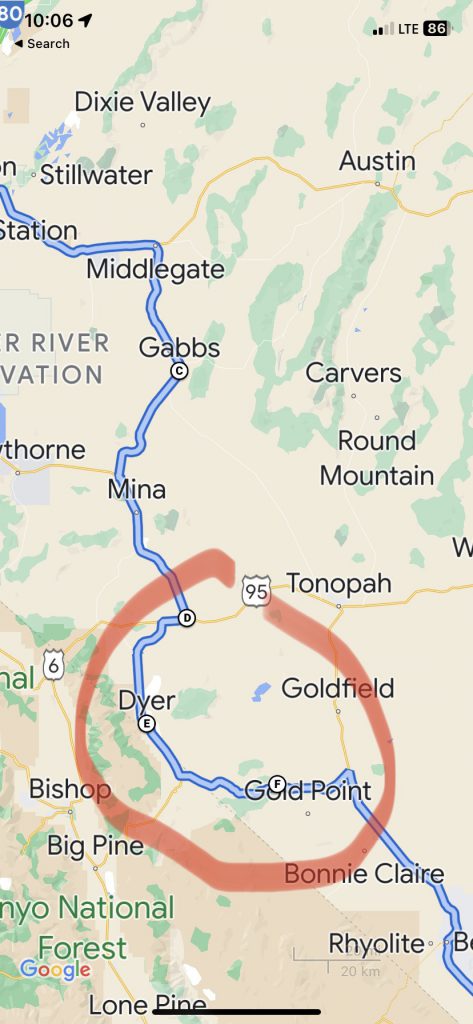
Continuing down US95, I resign myself to just riding the cruise control to Vegas, when my phone, who I swear now reads my mind says “this alternate route will only add 16 minutes”
I look and it is a string of small Nevada, and California highways that loop south and west in opposition to 95’s east and south route. I click it, and follow these roads. They are amazing. Utterly empty and with a stunning view of a snow covered mountain range that runs along the border, but mostly in California. At the apex, it runs through an agricultural valley, but the first and third thirds are delightful rolling hills. It is a wonderful alternative to the US95 slog. Despite Siri assuming it will add time, it actually ends up saving me quite a lot of time. Near zero traffic, I just fly along with my thoughts, once again experiencing the open roads that my father and I loved so much back in 1999/2000. It is appropriate to think of those great days with my father as it was five years ago today when he died. I was with him then, and I was with him again on these roads.
Rejoining US95 I again have to deal with other vehicles sharing the road with me. Oh well. I make it to Beatty, Nevada, which is a speed trap disguised as a town. I stop at a gas station to fill up the car, have a potty break, and refill my cooler with cold caffeinated drinks. As I’m doing this, the town cop issues at least three tickets, and has yet another pulled over as I leave the town. In Beatty, 25MPH means 25MPH.
Not long after leaving Beatty, I once again pass that Oregon Ford Phoney Cop car. It must have passed me while I was filling up with gasoline. Yep Siri, I gained sixteen minutes!
The rest of the run to Vegas is uneventful, beyond one wild donkey who crossed the highway in front of me. I even pick up a “rabbit” in the form of a Mazda minivan and a Toyota Camry who want to use the long divided section of 95 to travel at autobahn pace into the city. I let them pass and then pace them, but we’ll behind, to let my Valentine1 warn me if they get painted with radar. I pull into my hotel with almost two hours to spare before the event kickoff dinner. Time enough for a quick nap, and dreams about Highway 318 on the return voyage.