In step one I covered collection, filtering, and settling the waste vegetable oil. Next comes the actual process of chemical conversion to BioDiesel. This is the most complex portion of the process. Plenty has been written online about this, so I’ll provide links for details and really just touch the highlights here. Please be aware that I am NOT a chemist, so this write up is overly simplified for non-technical readers. Don’t get too nitpicky with my generalizations, ok?
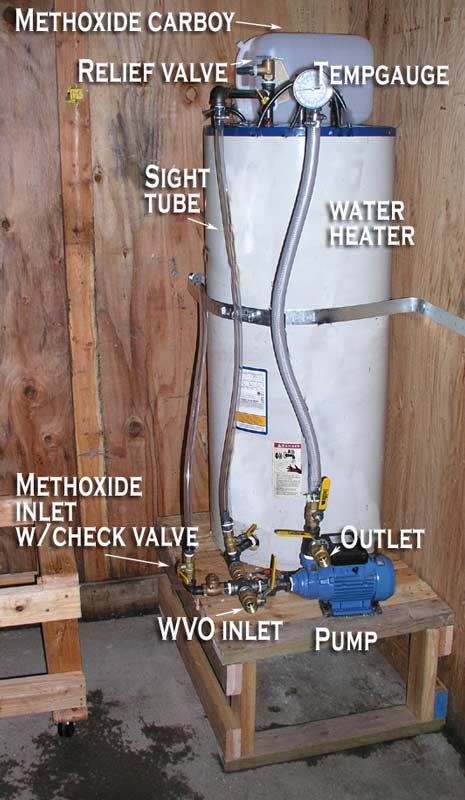
I move the WVO into the processor. The processor is basically an electric hot water heater that has been modified. The top heating element has been bypassed so only the bottom element remains active. Attached to the tank is some plumbing, valves, and a pump. The plumbing allows the oil to be recirculated through the processor as a closed system, or pumped in or out. At the top of the recirculating plumbing is a temperature gauge so that I can monitor the temperature within the reactor. The plumbing also provides a view to the level of oil inside via a sight tube, which I have calibrated with marks at 5 liter increments. At the top of the processor is a pressure relief valve, and a ball valve that allows me to vent the reactor. I have plumbed this through the wall and outside the barn with a hose.
After the oil is inside the reactor the heating element is turned on and the contents are heated to between 48° – 55° C (120° – 130°F.) The pump is run to ensure the oil is well mixed. Once the oil reaches the desired temperature I turn OFF the heater element. The next steps involve flammable liquids so it is best to remove heat sources. The element is surrounded by veggie oil, whose flash point is very high, but why risk it? The water heater tank is well insulated, and I have found it will hold the oil at the proper temp for many, many hours. No need to keep the heater on at this point.
In order to process you must first analyze the oil in a procedure called titration. Using the result of the test allows you to build a recipe to process the oil into BioDiesel. You use a set of fixed chemical amounts and introduce a marker and a single variable. When the marker shows a color change you have determined a value to enter into your recipe. A step by step guide to the titration of WVO is found here. I usually perform three tests and average the result to build my recipe.
The recipe is basically an amount of two ingredients to introduce into the oil. The primary chemical that does the work is a strong base. I use Potassium Hydroxide (KOH) which comes as white flakes. The amounts of the strong base used are relatively small, roughly 7% of the volume of waste veggie oil. However you can not just mix it in. You need to make a solution that will allow you to introduce it into the oil and create a reaction, resulting in a process called “Transesterification.” The ingredient used to make that solution is Methanol (MeOH). You generally use an amount of methanol equal to 22% of the volume of waste veggie oil. I wasn’t paying attention in Junior High Math class (I was doodling pictures the entire time… really) so I use a handy recipe calculator once I have finished my titration process.
Both KOH and MeOH are rather nasty chemicals.
KOH is caustic, and will cause chemical burns if it gets on your skin.
MeOH is poisonous, and will cause blindness, or even death.
I wear thick chemical-proof gloves, a chemical-proof apron, a respirator and a face shield when I deal with these chemicals. I also do all my mixing in an open area, out of the rain, but not enclosed. Lots of ventilation and a water supply very close at hand.
I store my KOH in a airtight, waterproof, sealed plastic drum. Inside the drum is the bag it comes in and that is kept closed. I use a plastic garden trowel to measure out the KOH and that trowel stays inside the drum, but outside the bag. I never touch this trowel with an un-gloved hand.
I buy my MeOH in a 55 gallon drum, but it is stored inside our Diesel fuel bunker at work, since we have a fuel storage permit there, and it is a safe environment. I have a rotary pump on the drum and bring home MeOH in a 5-gallon container, since that is the maximum amount that I ever use. I never touch the methanol. It moves from the drum to the container with a hose, and I always wear chemical-proof gloves when handling the container or pump. The only time the MeOH is exposed to the air is in the mixing process I’m about to describe:
Making Methoxide.
Once the recipe is determined, I measure out KOH on a digital scale with a tray that can hold close to 2kg. Once the right amount is measured it is transferred into a carboy (a large 22 liter HDPE container with a built-in screw-cap vent. I use a large funnel which has screw-on covers at either end to make sure that no amount of either chemical is spilled in the process. The carboys have been calibrated with liter markings on the outside so I can then add the right amount of MeOH into them.
I seal the carboy’s large opening, but crack open the vent. The resulting chemical reaction between the KOH & MeOH generates heat and some gas, so it must be vented. I let this sit, usually for 30 minutes or so, until all the KOH is completely dissolved.
Inducing Transesterification
The Appleseed BioDiesel processor is a fantastic design in that it allows the chemical reaction to happen with minimal risk to the operator. The entire system is easy to build with materials found at any hardware store, and the exposure to these chemicals is minimized since the system is essentially closed.
The carboy attaches to the processor via a special lid, which has a hose coming out. By cracking open the carboy and processor’s vents, and then opening the methoxide inlet (with built-in check valve to prevent oil from coming back up the inlet line) you can control the mixture of the chemicals. From what I understand You want to slowly add the methoxide to the oil so that it is evenly distributed. I usually do 90 liter batches of oil, so I have roughly 20 liters of methoxide to mix in. I allow it to enter at a rate that drains the carboy in about 10 minutes. The carboy sits on its side on a shelf at about waist height. I never get it too high off the ground as if the carboy were to leak or break, the resulting splash could be quite hazardous! I’m paranoid so I wear my gloves and face shield until I’m confident that everything is going well. At this point the processor is doing all the work. The pump circulates the mixture and better living through chemistry is on the way.
I’ve never, ever read any guide that tells me how long to let the process run. From what I have observed it continues as long as the three main elements are present. I usually let the processor run for several hours, even overnight if I start it later in the evening. When I believe the process is complete, I use the ball valves and my plumbing to move the mixture into the next bit of equipment in the process, the wash tank.
The washing of BioDiesel is one of those passionately discussed topics, and it is likely the most misunderstood. It will be the topic of the next installment of this series. Before that however is one more small step: separation.
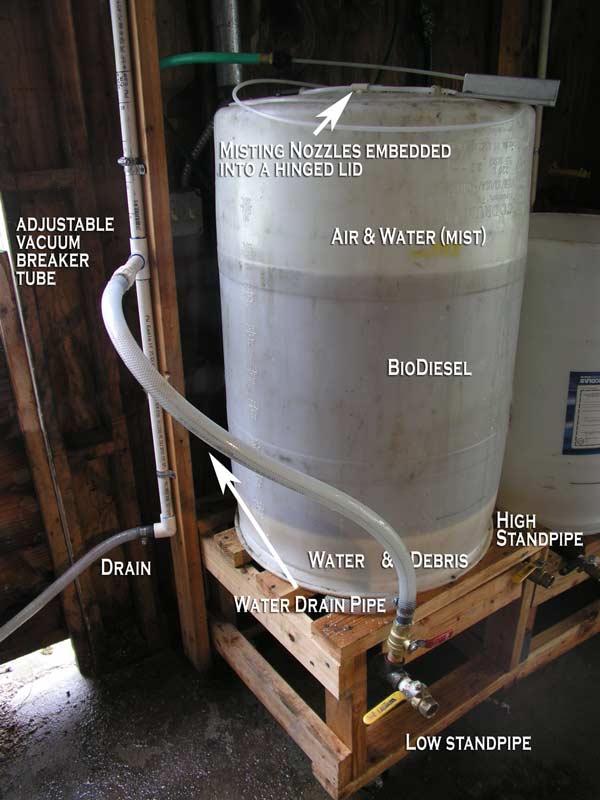
I have learned after many months of home brewing fuel that time is on my side. The slower I go, the better my fuel. The rhythm I have fallen into is “cooking” my BioDiesel on the weekend, and letting it sit in the wash tank for the full work week before I separate it. I imagine (remember, I’m NOT a chemist, so this is just a hunch on my part) that the reaction continues as it sits in my wash tank. The process likely slows to a crawl as the mixture cools to ambient temperature. Gravity also works on whatever stuff might still be in suspension… microscopic food particles mostly. The byproduct of BioDiesel production is Glycerin. This falls out of the mixture and settles at the bottom of the tank. It is a thick, black liquid that looks very much like the stuff in your lava lamp… except it is black. The stuff floating above the glycerin is BioDiesel.
Just like the settling tanks I described last time, the wash tank has a two-level drain system. One drain removes the glycerin off the bottom of the tank. I pour it off into “cubees” (the roughly 5-gallon box-shaped HDPE bottles the virgin oil is sold to restaurants in) and set it aside. I’ll address dealing with the byproducts in a later post.
Next up: Washing.