In the last article in this series I covered washing BioDiesel. Now we move on to drying it.
After you wash BioDiesel it is (mostly) free of particulate impurities, but now it is contaminated with water. Tiny droplets of water remain in suspension in the BioDiesel. Water in your fuel is not a good thing. Removing it is easy, as oil and water naturally want to separate. You can just let it sit and nature will take its course. This is what I have been doing until recently. However sometimes you want to give nature a push. You can bring the BioDiesel into contact with as much air as possible. You can also heat it up. The best is to do both. This step is referred to as “drying”.
I generally let my washed BioDiesel sit for a week anyway, to let as much water fall out as possible. After that I run it through my Drying Tank. The Drying Tank is something I built recently and I’m REALLY happy with the quality of my fuel since I started drying it actively, rather than just letting it sit. In fact I have dried all the fuel I had sitting around for the past few months slowly settling.
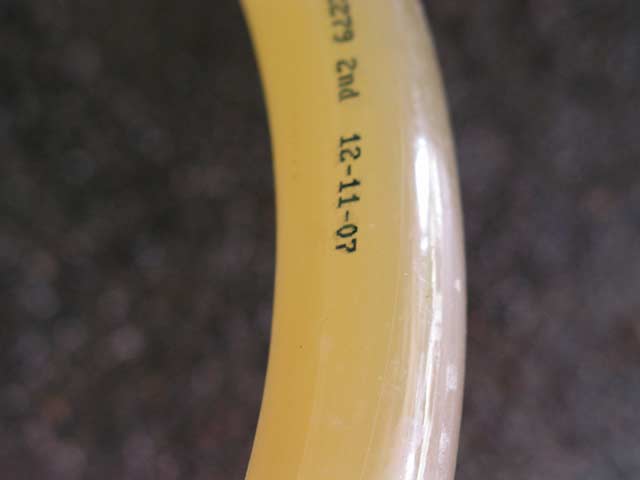
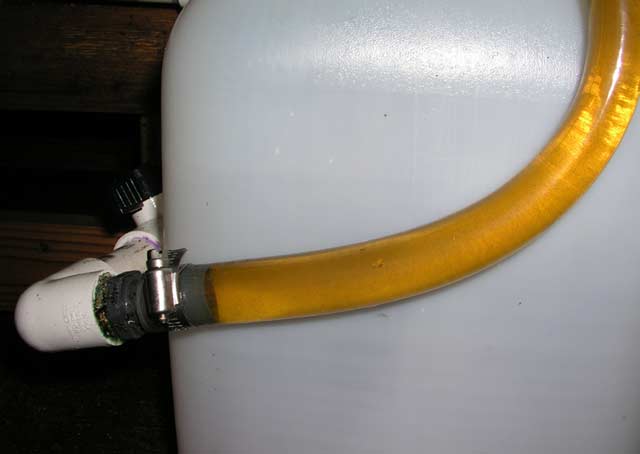
When the BioDiesel has been washed, and has water in suspension it looks like orange juice. See the photo above for an example. That is washed BioDiesel viewed through a clear tube. Note how opaque it is.
To dry the BioDiesel, it goes in here:
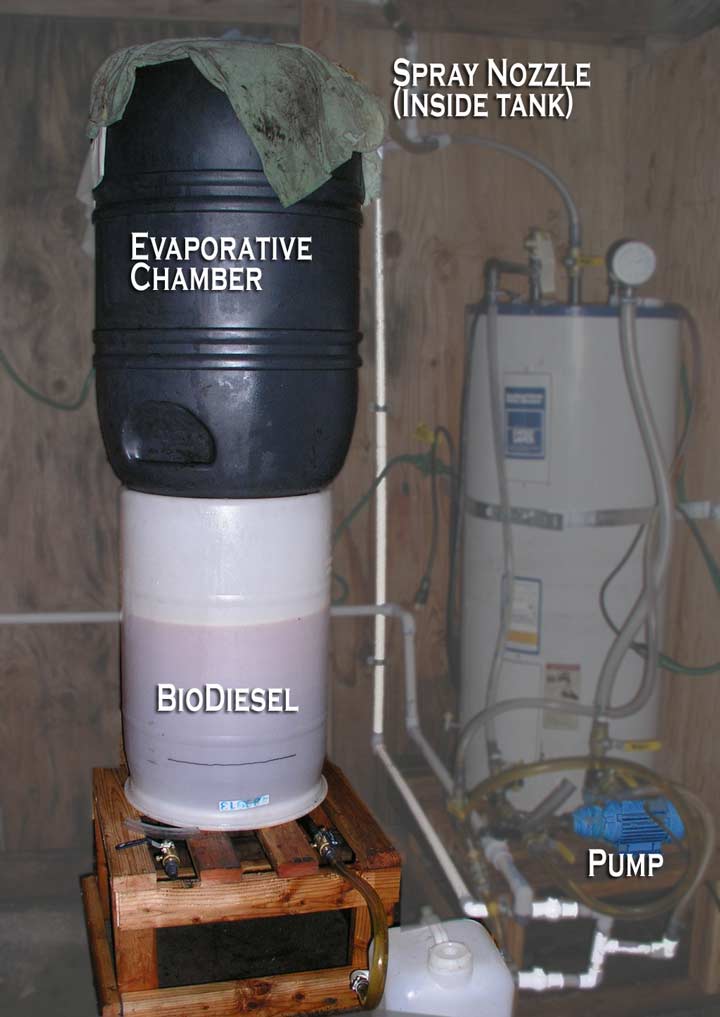
This is my drying tank. It is basically an inverted barrel with standpipes in the bottom. It has been cut around the rim of the top (formerly the bottom) and had a larger, contoured barrel placed into the hole. This barrel has a set of perforations drilled into the very top, along with a hose from the pump run through a hole in the top, fitted with a wide-angle spray nozzle. The BioDiesel is pumped up to this nozzle and sprayed onto the interior surface of the top barrel. It flows down the sides and then falls into, and collects in the bottom barrel, where it drains through one of the standpipes into the pump again. By recirculating the BioDiesel into this cooling-tower-like structure it is exposed to a lot of air. (You will note a dirty old t-shirt at the top of the tank. I added this to keep the BioDiesel mist from leaving the tank and covering the barn with an oily residue. Air can still pass through it, but most of the mist is contained.)
Over time, the BioDiesel clears up as the water is forced out by the drying process. I suspect that most of the water evaporates out of the oil. I have noticed that it also separates out of the oil and pools at the bottom below the level of the standpipes. The oil clarifies and becomes very clean looking:
Note how clear it is!
Heat seems to speed the drying process up quite a bit. My drying tank has no heater so if it is cold, I can pre-heat the washed BioDiesel inside my reactor.
After it dries, the BioDiesel is pumped into my gravity-fed final settling/filtering tanks, which I’ll illustrate in a future post. Stay tuned for more.